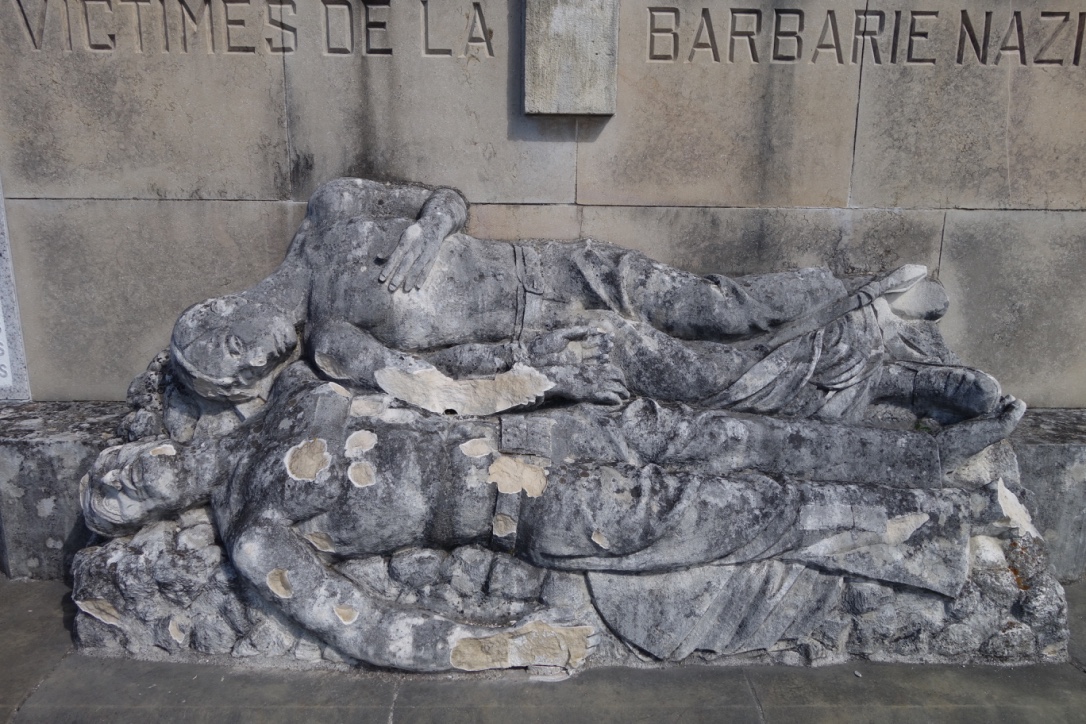
Narrative by Roland
Many French towns are named after saints. So many, in fact, that there are multiples of the same name across the country. The village of Sainte Radegonde is unique in France. In a cruel contradiction to the saint’s real life history of generosity and compassion, the name of this village in Aveyron is remembered now for a spine-shivering event.
It was August 1944 in the south of France. The Nazi army occupied the entire country and had been surprised by the Allied invasions of Normandy and Provence on D-Day. But very quickly they regrouped and organized their military divisions spread throughout the country to converge on the heated battle areas.
The French resistance had been growing steadily since the war’s beginning, becoming better organized, developing sophisticated communication and weapons transit networks throughout the country, linked with individuals in nearly every village in every region.
Since June of 1944 the Resistance had thrown their resources against the German army to slow its progress however they could, attacking the columns as they moved toward the northwest, setting ambushes and fighting at every opportunity, whenever they had a chance, in support of the allies. Their goal was to stall the German response to the Allied invasion.
Every region of France and every department, including remote, wide-open Aveyron had a network of courageous Resistance supporters. In August of 1944 the military barracks of the principal town, Rodez, held nearly forty of them, including people arrested randomly by the Germans in the previous months. These Resistance supporters were not all fighters. Some were farmers who had been intercepted delivering weapons in their tractors. Some were stonemasons who drove Resistance messengers to the next town. Some were office clerks who were seen with suspected Resistance associates. Some had been stopped while carrying anti-German literature, and some were reported for simply talking publicly about the German occupying army with scowls on their faces.
The German division occupying Rodez had received orders to depart the region and move toward the action, several hundred kilometers away. They quickly organized while their entourage of bureaucrats decided how to best use their resources, disengage the troops, and ironically, dispense with evidence of wrongdoing.
On August 17, the SS commanders in Rodez received permission to remove the 30+ prisoners from the military barracks. They made arrangements to load them into trucks and drive them four miles east, to a former French military compound. One SS commander contacted his Gestapo colleagues, enroute from the town of Albi in western Aveyron, to meet them just outside Rodez. The commanders needed their services. Today.
As soon as the Gestapo team showed up the 30 prisoners were driven to an abandoned shooting range, and pushed off the trucks. As they were lined up, the German soldiers assembled, facing them. At some point a song began and rose, loudly enough so that nearby farmers could hear it. It was La Marseillaise, the French national anthem. As they sung, the sun was still high in the sky, the magnificent cathedral of Rodez lay in the distance, and the snow-covered peaks of the Massif Central could be seen as clearly as if they were a short walk away. The rifles and machine guns fired, and the patriots fell.
The SS soldiers, thorough as ever, walked among the immobile bodies and shot each of them again to make sure they were dead. They tossed the bodies into a trench, then shoveled dirt on top. Job finished, they got back in their trucks and returned to Rodez.
That evening the occupying German army departed Aveyron forever.
 Francescapes:
Great story Roland! You sure have a gift for writing, no kidding!
As we would say: “on s’y croirait”
Still… From my position as a local – well, seen from the US, I am one most probably! -, you sound a little bit carried away by emotion and lyricism : let me point out one detail that does not match with the realism of your emphatic tale. Indeed, there cannot be any “snow-covered peaks of the Massif Central” by mid August, even in that pre-global warming age of 1944…
😉
LikeLike
Oh Pierre — it’s called artistic license. And there was snow on the Massif Central when we visited a few days ago. But good catch anyway 🙂 Malana
LikeLike
So sad… I miss you guys! Happy Friday, Lydia
>
LikeLike
I know it was a truly tragic story — we miss you too Lyd!
LikeLike