Dear Friends and Family,
I haven’t posted any blogs or sent any emails for, I guess, a few weeks. The main reason is that Malana and I finally succeeded in getting the attention of a few real estate agents in the Dordogne, and we’ve been driving unknowable distances on windy roads at low speeds in order to view their recommendations. This makes for very long days. I look at a map and say “Ah, that looks like it should take 20 minutes.” But due to our lack of a trustworthy GPS, large scale maps, frequent wrong turns and traffic calming when we go through villages…a trip of half an hour would take more than an hour. By driving so much we’ve been spending most of our bank account on gasoline, which costs about 3 times what it does in California.
Fortunately, in the days between our visits to farms or village hovels, we’ve been meeting lots of people, practicing our French, and picking up local history and stories.
At night I’ve been dodging among three books in French. Very slowly. The first is a novel by Ken Follett called Pillars of the Earth (“Pilliers de la Terre”). It’s relevant because it tracks the story of a 12th Century carpenter/builder in England who is looking for a job from the main client, the Church. When we pass churches and rectories or abbeys I am beginning to recognize the architectural styles and how they’ve been built alongside or on top of each other over the centuries. My eyes widen and my jaw drops and I take photos that would look like meaningless patterns of old stones and angles to anybody wanting to look though my vacation album.
The other two books I’m reading are local history that are difficult for me to understand and digest because I get tired of reaching for the dictionary so frequently. (Sometimes I wish a had a fast-moving thriller to read in English, perhaps something that reinforces my escape from the contorted cradle of social media…)
We visited a few properties in the Gers (department in the region of Midi-Pyrenees) and in Tarn et Garonne, and in Aveyron. Now we’ve started exploring the Dordogne again. The architectural styles throughout southwest France include rough farmhouses with huge dimensions and enormous wooden beams, stately ‘manoirs bourgeois’ with classically balanced grand salons and elegant bedrooms with tall windows, character houses like the steep, slate-roofed houses of the Dordogne, with miniature doors and curious corners. Walls are never made of wood – they are all of locally quarried stone…It’s hard not to fall in love with everything you see.
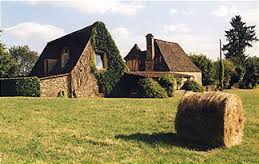
The real estate agents in France are called Agents Immobilier, which I believe is derived from the Latin for “rodent”. They seem to want to drive us to remote corners of farmland to show us properties that they are sure we will fall in love with, usually a ruin requiring years of work to put back into operation. As we examine the property—typically something without modern plumbing—we can see the agents, rubbing their paws and twitching their whiskers.
While we consider buying property in France we try to focus the agents on showing us revenue-generating estates only. We hand them a prepared document consisting of our well-considered purchase criteria in the form of a ratio-weighted scorecard. It’s basically a list of characteristics that are impossible to find. Something like:
A chateau on 100 acres, in excellent refurbished condition with all period details, within walking distance of a boulangerie… Chateau must have old tall, noble trees, horse paddocks and stables (with horses), and include six or seven high-end bed and breakfast rooms. The property will have multiple sources of income, and generate at least $100000 in revenue within a 6-month period. There must be views from every room…and the closest village must be a UNESCO-sponsored world heritage site.
Ask me how close many properties actually come close to meeting that description – and you might be surprised.
Parts of the Dordogne are known as the Green Perigord (for its wet, dense forests), the White Perigord (for its chalky hills), the Purple Perigord (for its vast vineyards) and the Black Perigord (thick tall dark chestnut and oak forests generate black truffles). Naturally, anyone who lives in any one of these regions assures us that it is the best place to live.
A property search in France (or any functional activity, for that matter) is interesting because of how quickly it enables you to learn about French society and behavior. My expectations of real estate agents were low to begin with based on my experience in the US. I have been adjusting them downward on a daily basis. Malana and I both had a bit of a breakdown yesterday because of the weight of the frustration with the process and it has caused a level of stress that is senseless – resulting in our stopping cold a few property research activities that we had in process.
I won’t detail it here right now, but the agents will do worse than not tell you something about a property. They will outright lie or misrepresent. (No!! Really??) It is a handy advantage for me to speak French well enough to speak directly to the owners of properties. My blunt and tenacious manner may unnerve an agent or property owner such that they can’t make up stories fast enough, so I usually end up learning the truth. But having to go through that 20-questions process every time we visit a property is fatiguing.
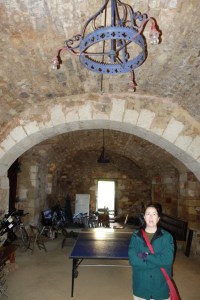
A few days ago, for example, we were visiting an enormous castle (offered at the price of a one-bedroom condo in San Francisco) and I noticed in one of the huge wine cellars some holes in the dirt floor that looked to me like water had been dropping there for some time, signifying some sort of sluice from above. The agent saw me looking at it (I make a point of staring at anything perplexing) and he quickly offered with a hint of surety that the round circles formed in the ground were caused by chairs that had been set up for an event. The property guardian, an old French man accompanying us as we walked around, volunteered “Oh, that was caused by water that leaked out of a broken pipe – that pipe right there.”
I love outdoor shopping for chateaux, but I would rather spend my time loitering at the café, socializing with men named Jean-Marie and women named Marie-Pierre; enjoying the formulaic ritual of greeting acquaintances passing in the street:
Moi: “Bonjour, Monsieur Dubois. Comment allez-vous?”
M. Dubois: “Quand il fait beau, on fait du bien. Et comment allez-vous?”
Moi: “Je fais bien, merci. Mes salutations a votre jeune fille, Marie-Pierre”.
M. Dubois: “Merci bien. Ayez une belle promenade, mon vieil.”
Moi: “Bonne journée.”
M. Dubois: “Bonne journée.”

